Burro’s Tail
Sedum morganianum · also called Donkey's tail, Lamb's tail, Horse's tail
Plump blue-green beads on long tails that dislike being touched
- Light
- Bright indirect, Full sun: Bright light with a few hours of direct sun
- Water
- Every 2-4 weeks, when the soil is dry all the way
- Difficulty
- Easy
- Pet safety
- Non-toxic to cats and dogs
- Size
- Medium
- Height
- Stems trail 1-3 ft
- Growth
- Slow
- Humidity
- Dry air is fine
- Temperature
- 60-80°F, keep above 40°F
- Good rooms
- Kitchen, Living room, Office
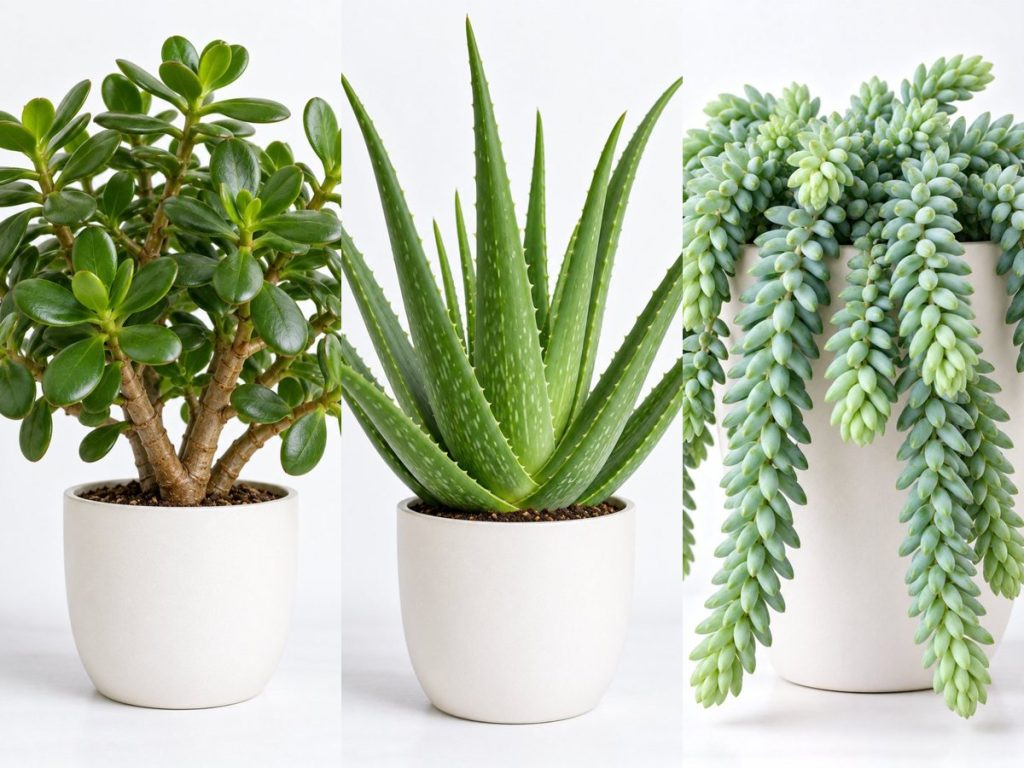
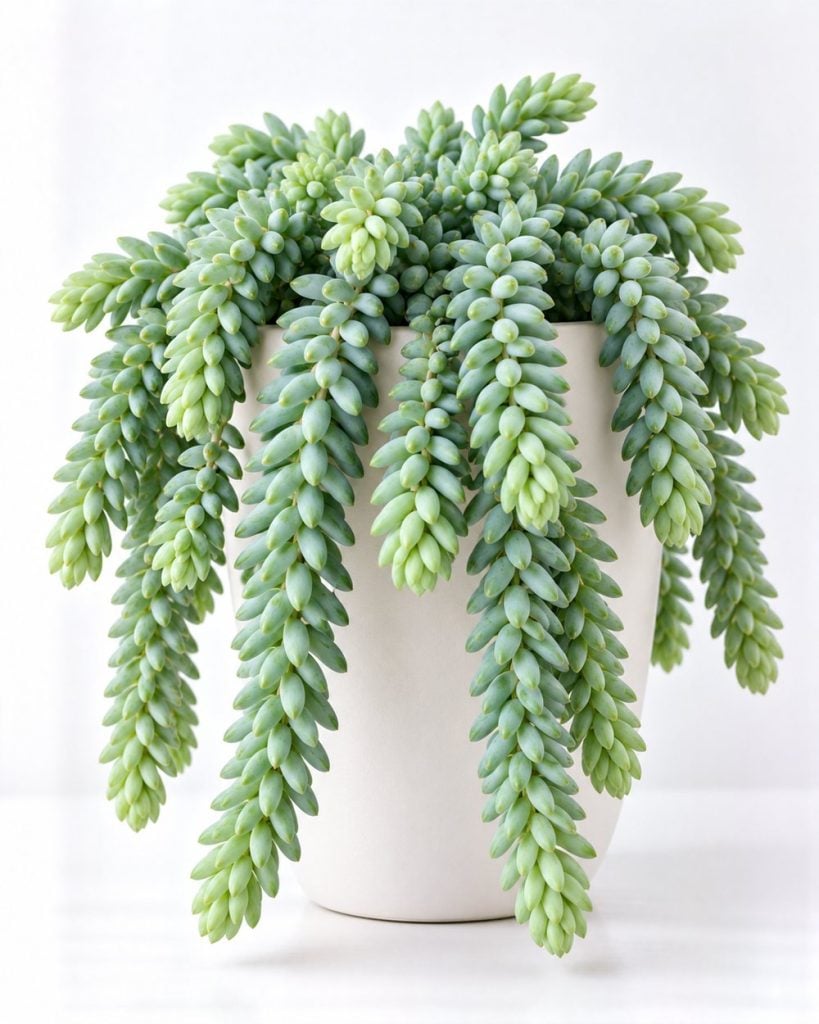
Brush past a burro's tail with your sleeve and you may hear a soft patter. That is leaves hitting the floor. This trailing succulent grows long, rope-like stems packed with small, plump, blue-green leaves, each shaped a bit like a jelly bean. They overlap like braided hair and hang straight down, 2 feet or more on an old plant. They also come loose at the slightest bump.
So the rule with this plant is simple. Pick its spot once and leave it there. A hanging pot in a sunny window where nobody walks by is perfect. A high shelf in a bright kitchen can work too. Every time you repot it, turn it, or carry it to the sink, you will lose a few leaves. The good news is that every fallen leaf can grow into a new plant, so nothing goes to waste.
Beyond that, it asks very little. It stores water in its leaves, so a missed watering is no big deal. It does need more light than most people expect. In a dim spot the stems stretch, the gaps between leaves widen, and the tails look thin and sad. The ASPCA lists burro's tail as non-toxic to cats and dogs. A cat that bats at the dangling stems can still make a mess, which is one more reason to hang it high.
Burro’s Tail care
Light
Bright light with some direct sun gives the fattest leaves and tightest tails. An east or west window is a good fit, or a few feet from a south window. If it has lived in a store, ease it into strong sun over a couple of weeks.
Watering
Wait until the soil is dry all the way through, then water well and let it drain. In summer that is often every two to three weeks. In winter, once a month or less. Wrinkled leaves mean it is thirsty. Soft, yellow, see-through leaves mean it is getting too much. A narrow spout lets you water without lifting the pot.
Soil and pot
Use a gritty cactus mix with extra perlite or pumice. A shallow, wide pot with a hole works best, since the roots are not deep. Clay helps the soil dry evenly. Hang it where you can reach the soil without taking it down.
Humidity and temperature
Normal home air is fine, and dry winter air is no problem. Avoid steamy, dim bathrooms. Damp leaves and stale air invite rot, so a spot with some airflow is better. It can sit happily near a sunny kitchen window, as long as it is not right over a steaming stove.
Feeding
Burro's tail stems are heavy and break easily, and rich feeding makes them softer. A low-nitrogen cactus fertilizer, used at quarter strength two or three times between May and August, keeps the beads firm. Always water the day before, so you are not pouring food onto bone-dry roots. Many growers skip feeding for a year after repotting into fresh mix.
Repotting
Repot as rarely as you can, maybe every three years, and only when it is badly crowded. Do it in spring while the soil is dry, and support the tails along your forearm. Expect to lose leaves. Save them for new plants.
Propagation
Lay fallen leaves on top of dry cactus mix in bright, indirect light. Do not bury them. Mist the soil lightly once tiny roots appear, usually after a few weeks. Stem cuttings root faster. Cut a 4 inch piece, strip the bottom inch, let it dry for a day or two, and push it into dry mix.
Common problems
Leaves keep falling off. Am I doing something wrong?
Some loss from bumps is normal. If leaves drop when nobody touched it, check the soil. Soggy soil and cold drafts both loosen leaves.
Why are the tails thin with gaps between the leaves?
That stretching comes from too little light. Move it to a sunnier window. The stretched stems will not tighten up, so trim them and replant the tips.
The leaves look shriveled and dull.
Wrinkled leaves mean the plant has used up its stored water. Give it a deep drink. They should plump up within a few days.
Some leaves turned pale yellow and papery after I moved it.
That is sunburn from strong sun it was not used to. Pull it back from the glass for a couple of weeks, then move it closer in steps. Burned leaves will not green up again.
Frequently asked questions
How fast do the tails grow?
Slowly, often a few inches a year indoors. A long, full plant is usually several years old, which is why big hanging baskets cost more.
What is the difference between burro's tail and string of pearls?
Both are trailing succulents. Burro's tail has plump, pointed leaves packed along thick stems. String of pearls has round beads on thin threads, and the ASPCA lists it as toxic.
Will it flower indoors?
It can, with small pink to red flowers at the stem tips in late spring or summer. Indoors this is uncommon and takes lots of sun and a cool, dry winter.
Not sure this plant fits your home?
Take a plant quizSources: www.aspca.org, plants.ces.ncsu.edu