Echeveria
Echeveria spp. · also called Hens and chickens, Mexican snowball
A wax rose of a succulent that needs a sunny windowsill
- Light
- Bright indirect, Full sun: Needs direct sun, at least 4-6 hours a day
- Water
- Every 2-3 weeks, only when the soil is fully dry
- Difficulty
- Moderate
- Pet safety
- Non-toxic to cats and dogs
- Size
- Small
- Height
- 2-8 in tall, 3-8 in across
- Growth
- Slow
- Humidity
- Dry air is fine
- Temperature
- 50-80°F
- Good rooms
- Kitchen, Living room, Office
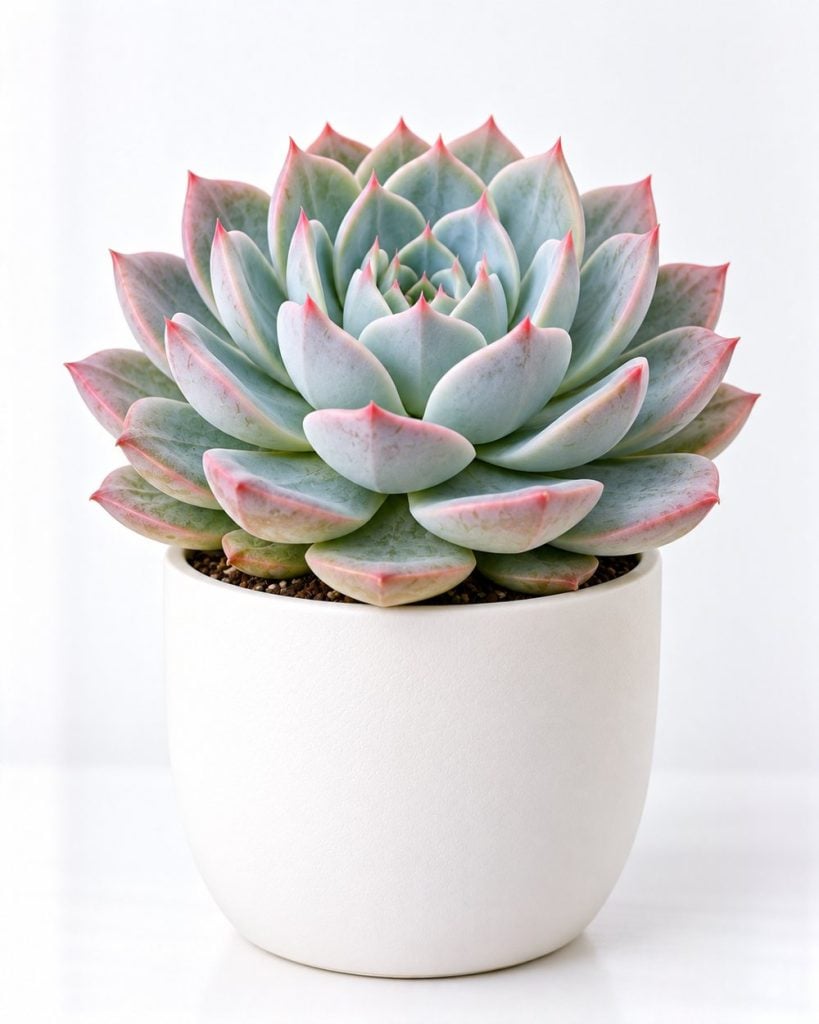
Echeveria grows as a flat rosette, leaf over leaf, like a rose carved from wax. Colors run from silver blue and sage to pink, purple, and near black. Many have a chalky white coating on the leaves, called farina, that rubs off where you touch it. Most stay under 6 inches across in a pot, so a few fit on one sunny sill. Some kinds stay as small as a golf ball. In late spring or summer, many send up a thin stalk of small bell-shaped flowers in orange, pink, or yellow.
Here is the catch most store tags skip. Echeveria needs a lot of sun. Indoors that means your brightest south or west window, or a grow light. Without it, the rosette stretches. The center rises on a pale stem and the leaves spread out flat, a change growers call etiolation. Once stretched, it does not shrink back. Plenty of echeverias die on desks and coffee tables, simply because they look so neat there.
Give it sun and it asks for almost nothing. It needs water every couple of weeks at most, never needs misting, and makes new baby rosettes around its base. Old leaves at the bottom dry up and drop as it grows, which is normal. The ASPCA lists echeveria as non-toxic to cats and dogs, so it is a good pick for a pet home with a sunny window. Do expect the odd tooth mark on a leaf.
Echeveria care
Light
Aim for at least four to six hours of direct sun a day. A south or west window is best. If the rosette opens up and leans toward the glass, it wants more. In a darker home, an LED grow light about 6 to 12 inches above the plant for 12 to 14 hours a day does the job.
Watering
Use the soak and dry method. Water until it runs from the drain hole, then wait until the soil is dry all the way down before the next round. That is often every two to three weeks in summer and about once a month in winter. Pour onto the soil, not into the rosette, where water can sit and rot the center.
Soil and pot
Use cactus and succulent mix, and add extra perlite or pumice so water rushes through. A shallow clay pot with a drainage hole is ideal. Skip pots without holes, which trap water at the bottom where you cannot see it.
Humidity and temperature
Dry home air suits it fine. Wet leaves can spot or rot, so leave the mister in the cupboard. Good airflow helps, so do not crowd it among leafy plants in a steamy bathroom. A kitchen windowsill works, as long as it is not right beside the kettle or a steaming pot every day.
Feeding
Echeveria grows in a tight rosette, and too much food breaks that shape. A cactus and succulent fertilizer, once in early spring and once in early summer, is all it needs. Never feed one in a dim room, because it will stretch toward the light even faster. Soft, pale, loose leaves often mean it got too rich a diet. Nothing from fall through winter.
Repotting
Repot every two years, or when baby rosettes crowd the pot. Spring is best. Let the roots dry for a day before planting in fresh dry mix, and wait about a week to water. Shake off as much old soil as you can, and check for dead roots or mealybugs while the plant is out.
Propagation
You have three easy options. Twist off a baby rosette from the base and pot it. Or wiggle a healthy leaf off the stem, let it dry for a few days, and lay it on dry mix until roots and a tiny rosette appear. A stretched plant can be cut back too. Take the rosette with an inch of stem, let it dry, and replant.
Common problems
My echeveria is growing tall and flat. Can I fix it?
The stretched part will not shrink. Cut off the rosette, let the cut dry for a few days, and replant it in a sunnier spot. The old stem often sprouts new rosettes.
The leaves turned mushy and see-through.
Clear, soft leaves mean too much water and the start of rot. Stop watering, pull off the mushy leaves, and check the stem. If the stem is black, cut above the rot and replant the healthy top.
Why are the lower leaves shriveling?
The bottom row drying up is normal as it grows. Pull them off once they are crisp, since dead leaves hold moisture and pests. If upper leaves wrinkle too, it needs a drink.
There are white cottony bits between the leaves.
Mealybugs like to hide deep in the rosette. Touch each one with a cotton swab dipped in rubbing alcohol. Repeat weekly until you find no more.
Frequently asked questions
Why did the color fade from pink to green?
Strong sun and cool nights bring out the pinks and purples. Indoors in softer light, many turn greener. More sun usually brings the color back on new leaves.
Should I wipe the powder off the leaves?
No. That white coating shields the leaves from sun and does not grow back where it is rubbed off. Hold the plant by the pot and the bottom leaves.
Can I grow echeveria in a terrarium?
A closed one is a bad idea, because the trapped damp air leads to rot. An open dish garden in a sunny window works much better.
Not sure this plant fits your home?
Take a plant quizSources: www.aspca.org, www.aspca.org, plants.ces.ncsu.edu